

Quiet House—Black Mountain, ca. 1951
Early Works, 1948-53
Beginning in 1948, Rauschenberg attended Black Mountain College near Asheville, North Carolina. His work at Black Mountain reveals many of the principal themes that recur throughout his oeuvre: sequences and progressions through time, grid formats, doubling and mirroring, and a sense of human scale. During these formative years, Rauschenberg used a wide range of art-making media, including printmaking, painting, photography, drawing (in both conventional and experimental techniques), and sculpture. As would become his hallmark, he often used media in combination, blurring distinctions between artistic categories. Collaboration with other artists would also remain an impetus throughout his career, and his early work with the composer John Cage and the dancer/choreographer Merce Cunningham inspired him to engage in conceptual modes and performance.
After settling in New York in fall 1949, Rauschenberg was introduced to the work of the Abstract Expressionists and began to incorporate their free brushwork into his own paintings. In the art he made both at Black Mountain and in New York, Rauschenberg expanded on the abstract idiom with the inclusion of recognizable images and materials taken from his immediate environment. He impressed gravel into the dark surfaces of his Night Blooming paintings (1951); the uninflected White Paintings (1951) became screens for light and shadow, responding to the conditions around them; and newspaper collages formed the grounds of the Black Paintings (1951–ca. 1955).
The collages and sculptures Rauschenberg made in 1952–53 while traveling with the artist Cy Twombly in Europe and North Africa contain many of his enduring motifs: body parts, modes of transportation, fine art reproductions, lettering, and diagrams. The fetishistic assemblages he made in Italy from found materials, as well as the Elemental Sculptures, begun on his return to New York in 1953, were laboratories for the later Combines.

Rauschenberg at Black Mountain College, near Asheville, North Carolina, 1951 or 1952. Photo: Cy Twombly, courtesy Fondazione Nicola Del Roscio

Light Borne in Darkness, from Blueprint Portfolio, ca. 1951

Untitled (Night Blooming), 1951

White Painting, 1951

Black Painting, ca. 1953–54

Rauschenberg seated between White Painting (1951) and Black Painting (ca. 1953) in his Fulton Street studio, ca. 1953

Untitled, ca. 1953

Bob + Cy, Venice, 1953

Works in the Scatole e Feticci Personali series on the floor of a room in the Pensione Lago di Alleghe, Rome, 1953. Photo: Walter Auerbach

Works in the Scatole e Feticci Personali series hanging in the Pincio Gardens, Rome, 1953. Photo: Walter Auerbach
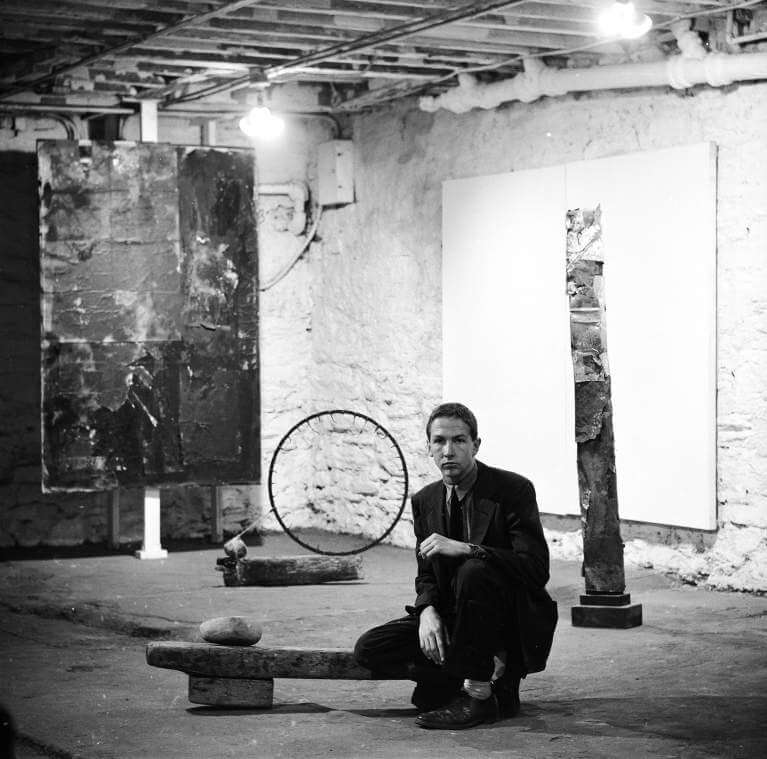
Rauschenberg seated on Untitled (Elemental Sculpture) (1953) at Rauschenberg: Paintings and Sculpture, Stable Gallery, New York, September 15–October 3, 1953. Other works shown: Black Painting (ca. 1951), White Painting (1951), and two Elemental Sculptures (both 1953). Photo: Allan Grant © The LIFE Picture Collection/Shutterstock