
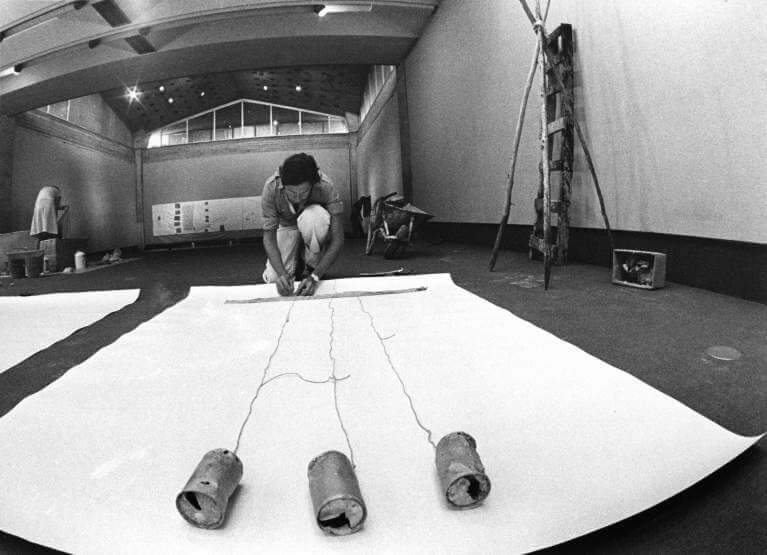
Rauschenberg working on Scripture (1974) for the exhibition Robert Rauschenberg in Israel at the Israel Museum, Jerusalem, 1974. Other works shown: Scripture I, Untitled, and Untitled (all 1974). Photo: Nir Bareket
International Collaborations,
1973–95
Rauschenberg’s belief in the power of art as a catalyst for positive social change was at the heart of his participation in numerous international projects. In the 1970s and early 1980s, he collaborated with papermakers in France, India, and China as well as with artisans at a ceramic factory in Japan. Through his travels, Rauschenberg collected a store of materials to use when he returned to his studio in Captiva, Florida, including photographs, objects, textiles, and printed matter. The resulting works were inevitably informed by his newly acquired understanding of another culture, yet the admixture of imagery and materials was always distinctly Rauschenbergian.
The Rauschenberg Overseas Culture Interchange (ROCI), the artist’s primary preoccupation between 1984 and 1991, was a tangible demonstration of his long-term commitment to human rights and to the freedom of expression. Rauschenberg financed the ROCI project himself and traveled to ten countries, exploring diverse cultures and local art-making practices and mounting an exhibition of his work in each country, often where artistic expression had been suppressed. His purpose with ROCI was to spark dialogue and promote mutual understanding through the creative process.
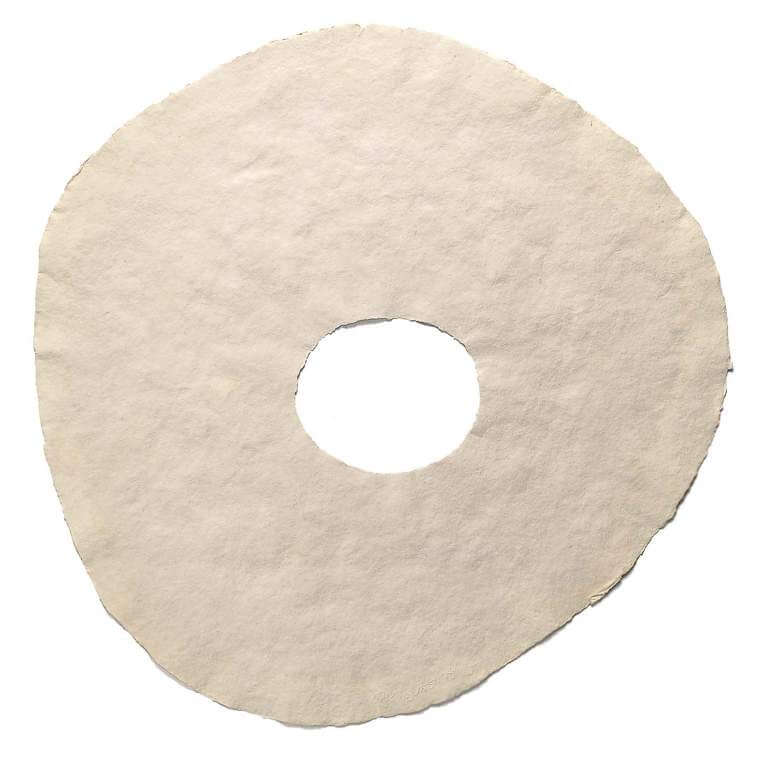
Page 2 (Pages), 1974
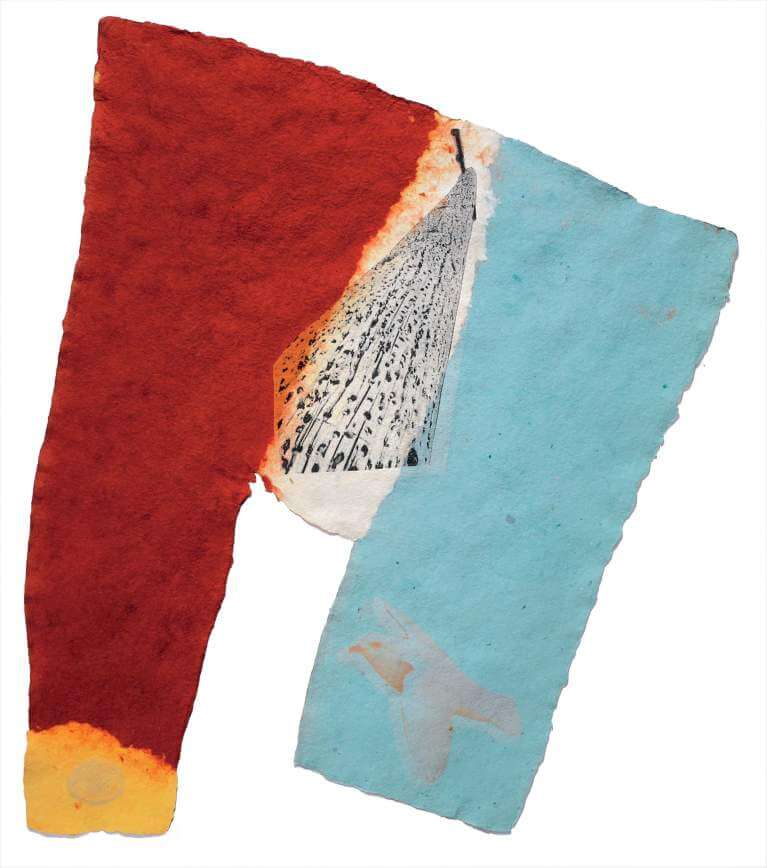
Link (Fuses), 1974
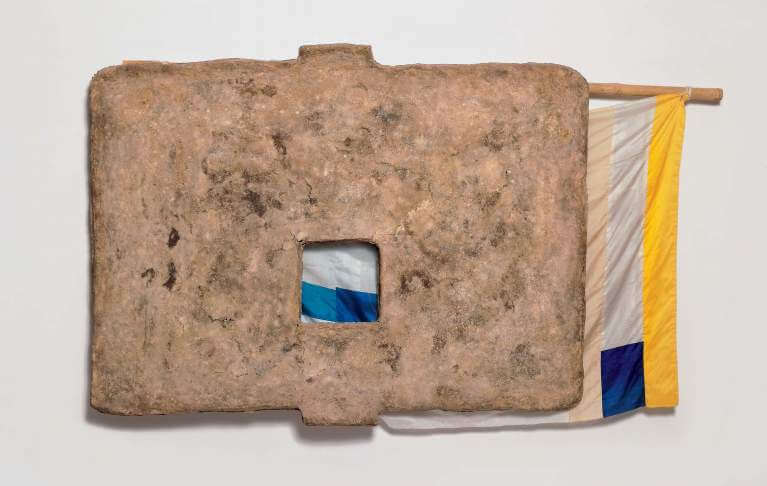
Capitol (Unions), 1975
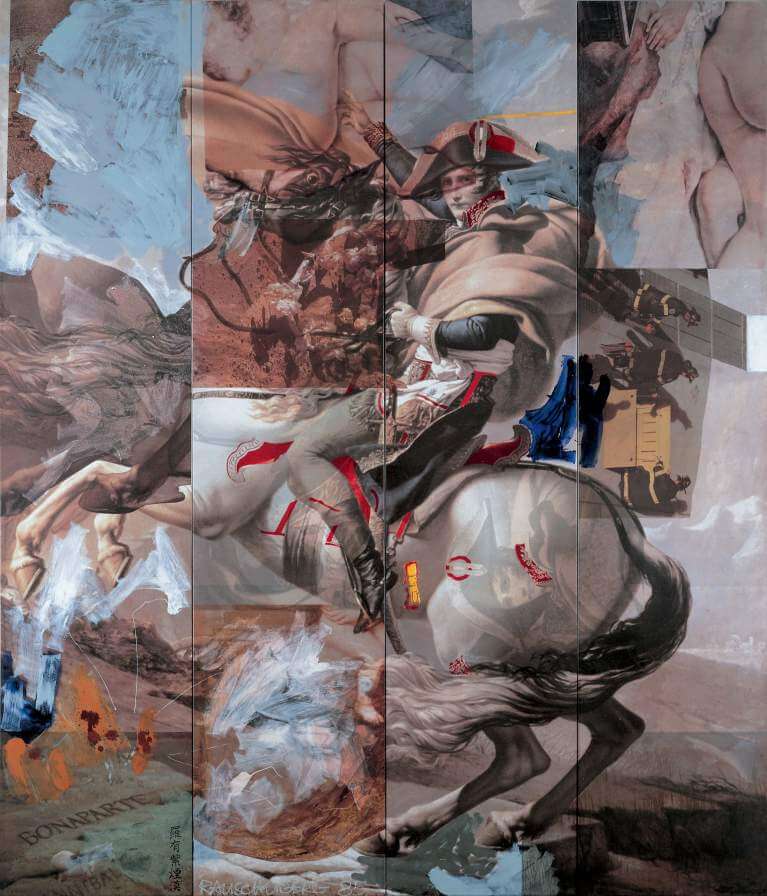
Able was I Ere I Saw Elba II (Japanese Recreational Claywork), 1985
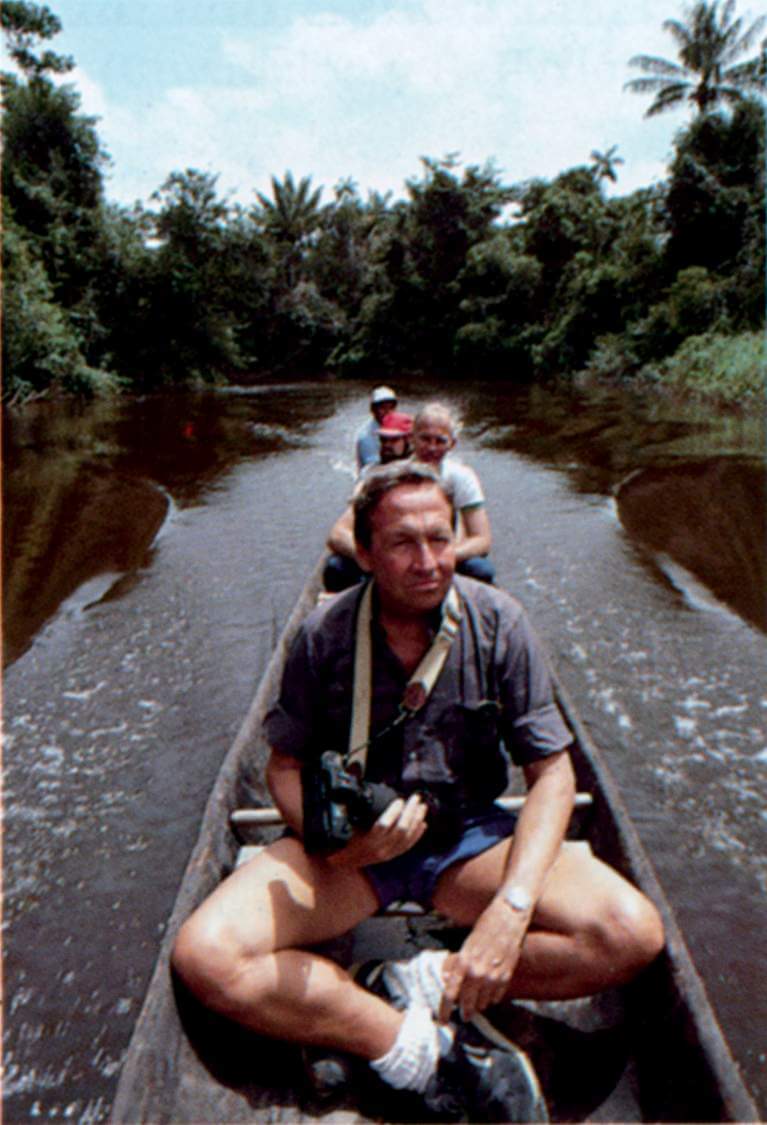
Rauschenberg taking photographs aboard a boat in Venezuela in preparation for his Rauschenberg Overseas Culture Interchange (ROCI) project, June 1985
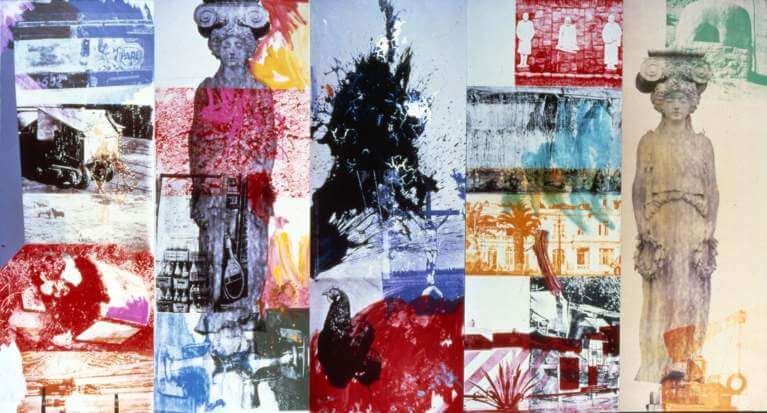
Caryatid Cavalcade I/ROCI CHILE, 1985
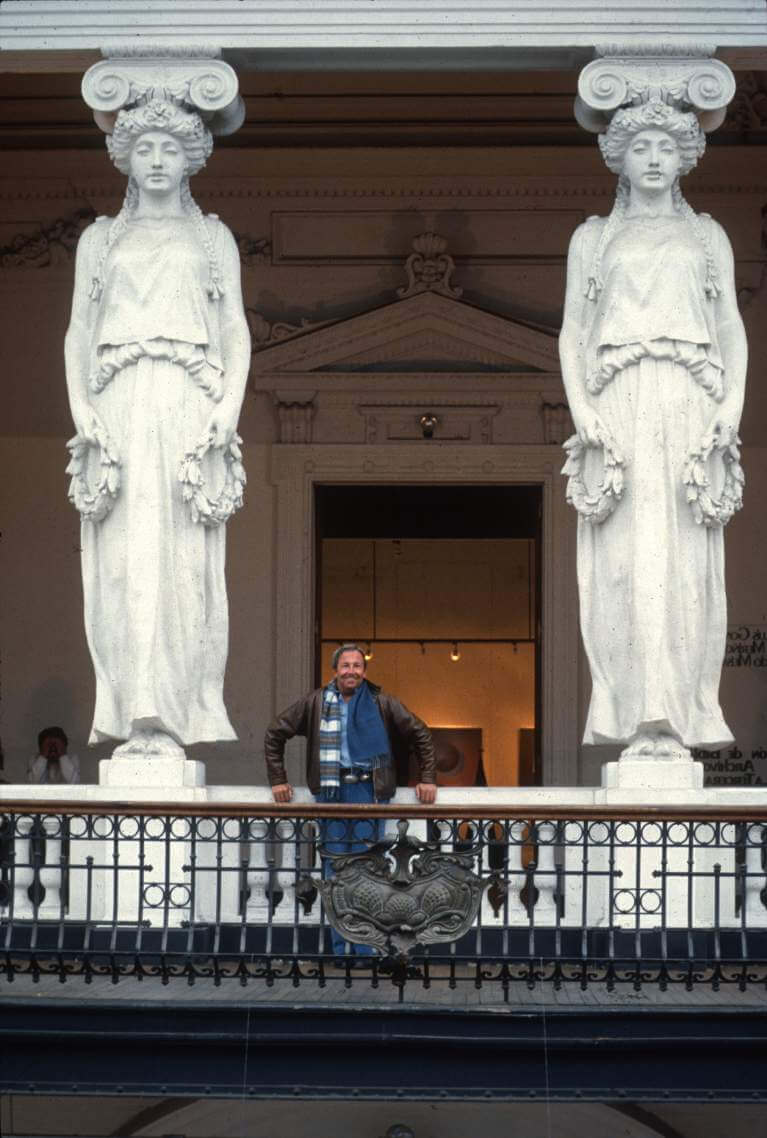
Rauschenberg standing on the second-floor balcony of the Museo Nacional de Bellas Artes de Santiago de Chile, the venue for El viajero mundo de Rauschenberg [ROCI Chile], ca. 1985. Photo: Terry Van Brunt
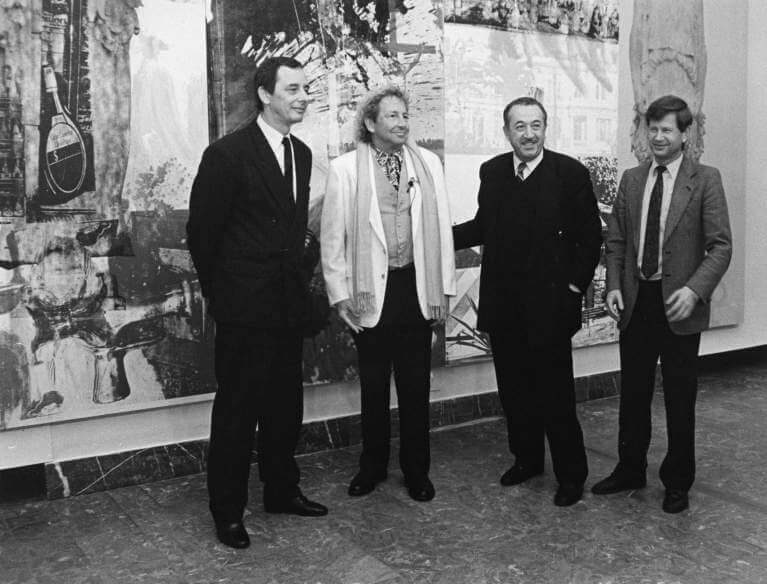
Rauschenberg (second from left) with Minister of Culture Dietmar Keller of the German Democratic Republic (GDR), Tahir Salakhov, and an unidentified man at the Neue Berliner Galerie im Alten Museum, the venue for ROCI: Rauschenberg International Culture Interchange [Berlin], March 1990. Work shown: Caryatid Cavalcade I/ROCI CHILE (1985). Photo: Elfriede Schönborn
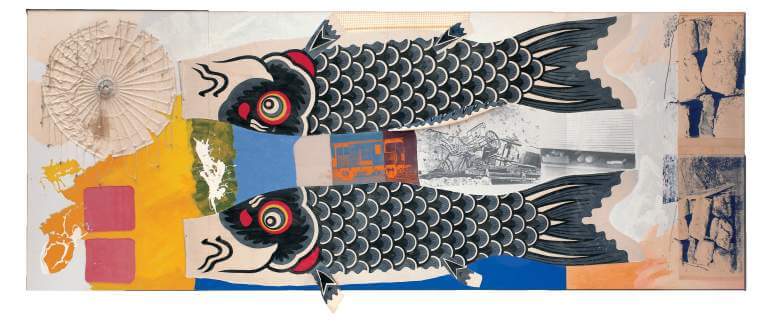
Doubleluck, 1995